


Image

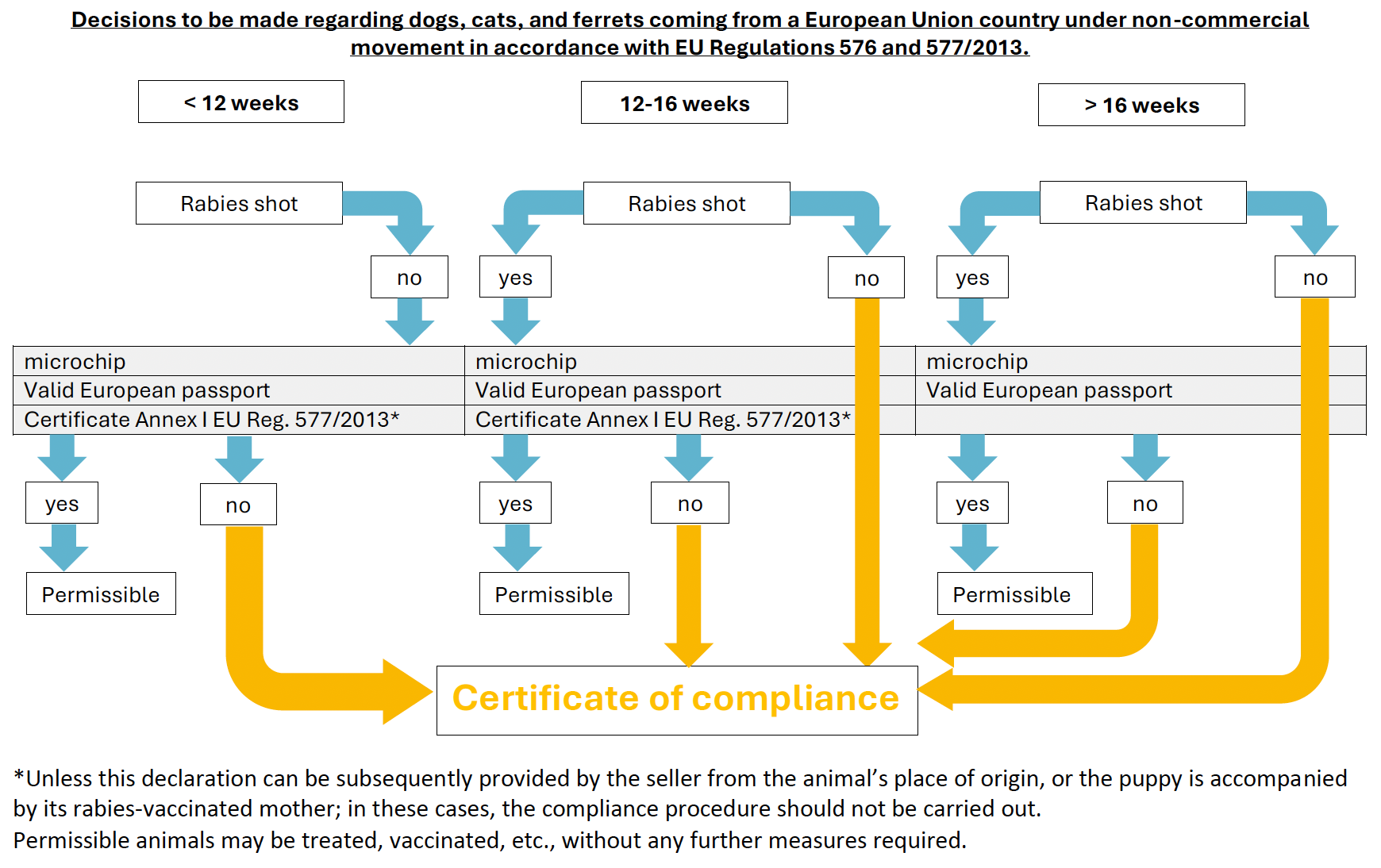
Since 29.12.2014, EU REGULATION No 576/2013 concerning all non-commercial movements of dogs, cats, or ferrets must be respected.

EU entry conditions:
be identified with a microchip (before rabies vaccination)
be validly vaccinated against rabies*
be accompanied by a European passport
comply with specific conditions (some Member States require additional preventive health measures)
Animals must have been vaccinated against rabies and may only cross the border after a 21-day waiting period to ensure vaccine efficacy. The rabies vaccine may only be administered to an animal at least 12 weeks old.
*Puppies/kittens under 12 weeks and unvaccinated against rabies, as well as those in the waiting period (between 12 and 16 weeks), are accepted in Luxembourg for non-commercial movements, provided they are accompanied by a very specific certificate (see Annex I of R. 577/2013) signed by the owner (= the breeder of the animal, the person responsible for the animal before it enters Luxembourg).
According to current information, neighboring countries (Germany, Belgium, France, Netherlands) do not accept animals under 15 weeks old (= 12 weeks + 21-day rabies vaccine waiting period), neither for import nor transit!
List of EU countries: Admission of animals under 15 weeks with certificate
List of EU countries: Admission of animals under 15 weeks with certificate |
|||
|---|---|---|---|
| Country | Yes/No | Country | Yes/No |
| Austria | Yes | Italy | No |
| Belgium | No | Latvia | No |
| Bulgaria | Yes | Lithuania | Yes |
| Croatia | Yes | Luxembourg | Yes |
| Cyprus | No | Malta | No |
| Czech Rebuplic | Yes | Netherlands | No |
| Denmark | Yes | Poland | No |
| Estonia | Yes | Portugal | No |
| Finland | Yes | Romania | Yes |
| France | No | Slovakia | Yes |
| Germany | No | Slovenia | Yes |
| Greece | No | Spain | No |
| Hungary | No | Sweden | No |
| Ireland | No | ||
| Other countries | |||
| Norway | Non | Switzerland | Oui |
Any dog, cat, or ferret that does not meet the three above-mentioned conditions and enters Luxembourg constitutes an illegal import and must follow a specific procedure: certificate of compliance.
Certificate of compliance:
Any dog, cat, or ferret imported into the Grand Duchy of Luxembourg that does not comply with the provisions of EU Regulations 576/2013 and 577/2013 must follow the certificate of compliance procedure, provided it is a non-commercial movement and the animal comes from an EU country. (Commercial movements and importation from third countries are not allowed for animals that do not comply with EU Regulations 576/2013 and 577/2013.)
To receive a Luxembourg European passport that allows movement within the EU, the animal must be identified by a transponder, vaccinated against rabies according to EU Regulations 576/2013 and 577/2013, and presented to a licensed veterinarian for health checks three times, with 2–3 months intervals between each check.
The European passport will be issued at the earliest 6 months after the 3rd veterinary check if the animal shows no signs of contagious disease.
Without a European passport, the animal cannot leave the country.
The Director of the Veterinary Services Administration may refuse this procedure depending on the case.
Non-compliance reasons may include, e.g., an unchipped animal, no rabies vaccination, missing European passport, non-European passport, old European passport accompanying an animal born after 29.12.2014, etc.
The animal’s owner may choose a veterinarian, but all three checks should preferably be performed at the same veterinary practice that will also issue the European passport at the end of the procedure. The original certificate is returned to the owner after each check.
If there is doubt about the animal’s health during the three checks, the veterinarian immediately contacts an official veterinarian from the Luxembourg Veterinary and Food Administration.
For further information, please contact ALVA.
For movements from third countries (TC), sanitary conditions set by the TC authorities must be respected.
Animals from TCs must be accompanied by an official veterinary certificate.
If animals come from a TC not listed by the European Commission, they must also undergo a rabies antibody titre test, performed at least one month after rabies vaccination. A further waiting period of 3 months after the blood test must be respected before movement to the EU.
The same procedure applies to any animal originating from an EU Member State returning to the EU after staying in a TC. In this case, the European passport replaces the official veterinary certificate.
The Luxembourg Veterinary and Food Administration recommends performing the rabies antibody titre test before departure to avoid possible refusal of the animal at the EU border upon return.
Animals introduced into Luxembourg for commercial purposes are examined in the Member State of origin by an official veterinarian who certifies via the TRACES system that the animals are healthy. The printed certificate and the European passport must accompany the animals upon introduction into Luxembourg.
For commercial importation from a third country, the animal must be identified, vaccinated against rabies, and accompanied by an official veterinary certificate.
More information:
Info [at] alva [dot] etat [dot] lu (Info[at]alva[dot]etat[dot]lu)
https://food.ec.europa.eu/animals/movement-pets_en